 Log in


 Cart
Cart
Loading...
Váš nákupný košík je momentálne prázdny.
Přidejte produkty do košíku.
Did you know that poor mattress firmness often leads to morning stiffness? A firmer bed doesn't automatically mean healthier sleep – often, the opposite is true. We'll show you how to choose mattress firmness so you can stop tossing and turning and finally sleep soundly.
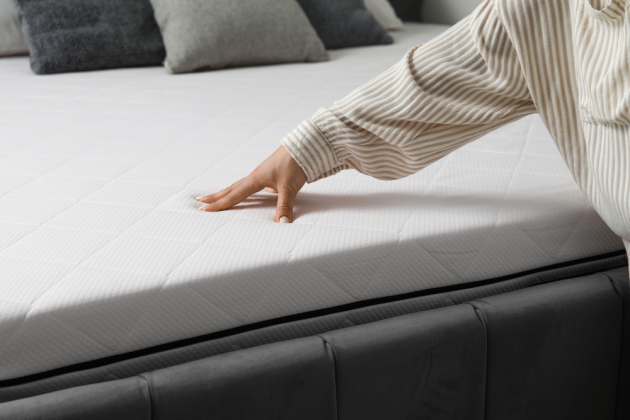
When choosing a new mattress, we often get lured by discounts or luxury covers, but the most important part is hidden inside. Mattress firmness (or stiffness) determines how well your spine will be supported during the night. The aim is clear: your spine must remain in its natural alignment, whether you sleep on your back or side.
Think of it this way:
At Purtex and in the Czech market, you're most likely to encounter firmness labeled on a scale from 1 to 5 (sometimes marked as T1–T5 or H1–H5). How to read between the lines?
These mattresses are like a cloud. They are the ideal choice for individuals with lower body weight (up to about 70 kg) and for those who primarily sleep on their side. Softer foam allows the shoulders and hips to sink deeper, aligning the spine.
Who is it for: Seniors (no pressure on joints), lightweight individuals, "side sleepers".
Clearly the best-selling and most versatile option. How to choose mattress firmness if you're unsure? T3 is often a safe bet. It provides solid support but can still adapt to the body's curves due to its comfort layers.
Who is it for: Both women and men, teenagers, couples with similar body types. Suitable for sleeping on the back or side.
Here, we're talking about a very firm base. These mattresses are designed for heavier loads or for individuals who require a firm bed for health reasons (e.g., as recommended by an orthopedist).
Who is it for: Individuals with higher body weight (over 100 kg), stomach sleepers, and those who prefer a firm bed feel.
For a more detailed explanation of individual levels, check out our glossary of terms: Firmness (stiffness) of Mattresses.
There is no universal mattress for everyone. When choosing, follow this holy trinity:
A frequent scenario in the bedroom. The man weighs 100 kg and wants a "board", while the woman weighs 60 kg and wants a "cloud". Buying one large mattress 180x200 cm with the same firmness is a mistake in this case.
The solution is two separate mattresses within one cover, or partner mattresses with differing firmnesses on each side (e.g., one side T3, the other T4). This way, each sleeps on their own, but without a gap in the middle of the bed.
If you are still unsure and need a comprehensive guide, we recommend our article: 5 Steps to Choose the Right Mattress.
If you have the chance to test the mattress (or test your current one), lie on your back. Try to slide your palm under your lower back.
Ready for a change? Check out our wide selection of mattresses and choose the right one exactly according to your needs.
The myth that the hardest mattress is best for sore backs is false. If your lower back hurts, a hard mattress can be the cause, as it doesn't support the natural curvature of the spine. Usually, the best option is medium firmness (T3), which combines support with adaptability.
Yes, every foam mattress will soften slightly over time. In the first weeks of use, a so-called "breaking in" of the materials occurs. So, if you're hesitating between two firmness levels, it's usually safer to choose the slightly firmer one.
Quality mattresses have different hardness zones (e.g., 5 or 7 zones). This means that the mattress is firmer under the head and feet, while softer under the shoulders and hips, allowing these wider body parts to sink in. This increases ergonomic comfort.
For children, medium-firm to firm mattresses (T3–T4) are generally recommended. A child's spine is developing and needs firm support, not soft sagging. Avoid zoned mattresses for small children who have not yet grown into the zones.
 Sale
Sale

 Mattress
 Solid Wood Beds
 Bed Bases
 Upholstered Furniture
 Action Sets
 Pillows and Home Textiles
 Health Positioning Aids
 Other PURTEX products
 Action Products at Discounted Prices
 Mattress covers
 Dog beds
 Discounted Goods